

Beside, Corner, Alone: How to Read Logic Puzzle Clues Precisely
Every logic-puzzle clue keyword has an exact meaning. Get “beside”, “in a corner”, “alone” and the rest precisely right and the grid falls into place.

Arena Editorial Team
2026-07-16 • 5 min read
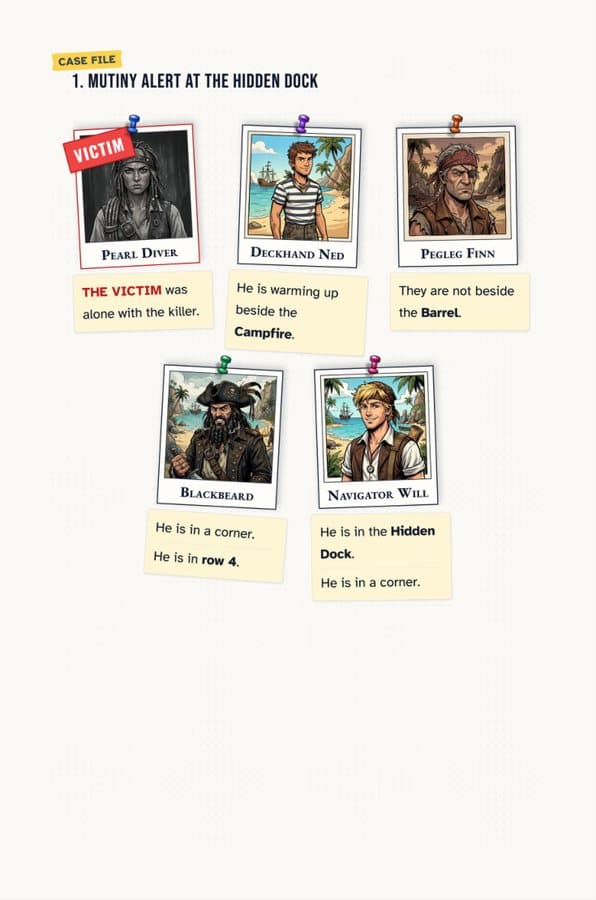
A logic puzzle is only as fair as its clues are precise — and the good ones are precise to the letter. Most “impossible” cases aren’t impossible at all; the solver just read a keyword loosely. Here is what each one actually means.
Beside
“Beside” means orthogonally adjacent — up, down, left or right — and in the same room. It is never diagonal, and a wall blocks it: a square across a room boundary is not “beside”, even if it looks one step away. If a clue says a suspect is beside the piano, they’re in a square that shares an open edge with the piano’s square.
In a corner
A corner is any square where a horizontal wall meets a vertical wall, including inside rooms — not just the four grid corners. It gets its own full guide because it catches everyone.
Alone in a room
“Alone” means exactly one suspect is in that room — no more, no fewer. It’s a powerful clue because it constrains everyone else out of the room at once, and it’s central to the reveal: the killer is whoever is alone with the victim.
In a column / in a row
Columns are lettered, rows numbered. “In column C” fixes one coordinate and, combined with the one-per-column rule, often pins a suspect faster than a room clue does.
Read the clue, then read it again
Before you shade a single square, restate each clue in your own words: which squares does it allow, and which does it forbid? Ninety percent of stuck grids come from a keyword read a little too loosely.
With the vocabulary nailed down, the three-step solving method does the rest.
Search Articles
Categories
Recent Articles
Love Word Search Puzzles?
Get puzzle tips, new book releases, and brain-boosting content straight to your inbox.